Posts

The South Niche ( Face 8 )

Image
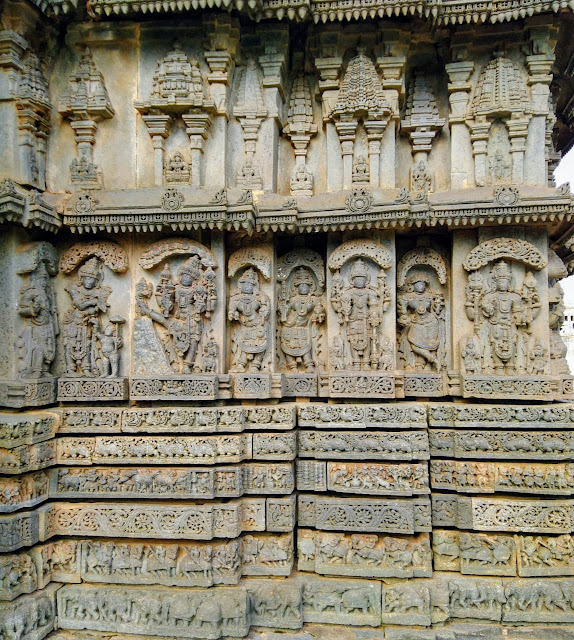
The SOUTH NICHE - FACE  8 The temple is provided with three single storied niches, one each on the south, west and north. They are carved like beautiful temples. They act as buttresses against the central tower of the temple. The photo above is that of the South niche. On the door jambs of this temple-like niche are seen the DWAARAPALAKAS also. All the other parts of a temple are provided too. The figures on the niche walls are small for want of space. Inside the niche is seen an aaseena DURGAA ( zoom to see ). VARAAHA wih consorts The left wall of the niche has an aaseena VARAAHA with consorts ( see the photo above ). Aaaseena NARASIMHA The right wall of the niche has an aaseena NARASIMHA ( see the photo above ).

Identifying the Large Images on the Central Walls - Face 7

Image
Face 7 of the wall Note : All the images are identified from your right to left. The images are : 1. GOVARDHANADHAARI. On the pedestal is a Kannada inscription which reads : HARI BIRIDA ROOVAARI GIRIVAJRADANDA VIRIDA PRASAADI MASTAKASHOOLA ROOVAARI NANDIYA BAICHOJA MAADIDA SRI SRI SRI ( ಹರಿ ಬಿರಿದ ರೂವಾರಿ ಗಿರಿ ವಜ್ರ ದಂಡ ವಿರಿದ ಪ್ರಸಾದಿ ಮಸ್ತಕ ಶೊಲ ರೂವಾರಿ ನಂದಿಯ ಬೈಚೋಜ ಮಾಡಿದ ರೂವಾರಿ ಶ್ರೀ ಶ್ರೀ ಶ್ರೀ ) meaning that it is the work of BAICHOJA of NANDI. 2. UGRA NARASIMHA with GARUDA ( ಗರುಡ ) to his left, LAKSHMEE ( ಲಕ್ಷ್ಮೀ ) to his right and PRAHLADA below. 3. HRISHEEKESHA ( ಹೃಷಿಕೇಶ ) ( C - P - S - G ) the tenth of the twenty-four forms of VISHNU ( ವಿಷ್ಣು )

Identifying the Large Imgaes on the Central Walls - Face 6

Image
FACE 6 : FIRST PART Note : All the images are identified from your right to left. The photo above is the first part of FACE 6 of the central wall. The images are : 1. TRIVIKRAMA ( ತ್ರಿವಿಕ್ರಮ ) ( G - C - S - P ) on the projected portion.To his left is a NAGA-KANYE holding a jewelled necklace. 2. BHAIRAVA with a goblin to his left. FACE 6 : SECOND PART The above photo is the second part of FACE 6. The images are : 1. Shadbhuja (six armed ) DURGAA ( ದುರ್ಗಾ ) dancing with skeleton body. A goblin is seen to her right. 2. VAAMANA ( C - G - P - S ) the eighth of the chaturvimshati murtis. 3. SREEDHARA ( ಶ್ರೀಧರ ) ( C - G - S - P ), the ninth of the Chaturvimshati murtis. 4. Two monkeys fighting for a fruit.

Identifying the Large Images on the Central Walls - Face 5

Image
Face 5 of the wall Note : All the images are identified from your right to left. 1. HARIHARA also called SHANKARANAARAAYANA. He is a fusion of HARI and HARA. He is seen holding a TRISHOOLA ( trident ) in his right upper hand ( HARA ) and a CHAKRA ( disc ) in his left upper hand ( HARI ). 2. MADHUSOODANA ( S - P - G - C ), the sixth of the CHATURVIMSHATI MOORTIS. To his right is his consort ( KAMALAALAYA ) holding a PAASHA and KALASHA. 3. TRIVIKRAMA with his right leg lifted. 4. VAAMANA receiving gift from BALI. SHUKRA standing to the right of BALI.

Identifying the Large Images on the Central Walls - Face 4

Image
Face 4 of the wall Note : All the images are identified from your right to left. 1. AMARANAARAAYANA or PARAVAASUDEVA seated on ANANTA. On the pedestal is the Kannada inscription : SRI AADIMOORTI DEVARANU NANDIYA BAICHOJA MAADIDA KANDIRE ( ಶ್ರೀ ಆದಿ ಮೂರ್ತಿ ದೇವರನು ನಂದಿಯ ಬೈಚೋಜ ಮಾಡಿದ ಕಂಡಿರೆ ). Below the god are GARUDA ( ಗರುಡ ), PRAHLAADA, and the other gods. 2. GOVINDA (G - P - S - C ), the fourth form of VISHNU with a consort to his right. 3. YOGAANARASIMHA with two consorts. GARUDA ( ಗರುಡ ) and PRAHLAADA below. 4. VISHNU ( P - S - C - G ) with consort. 5. Aaseena Chaturbhuja VARADARAAJA ( abhaya hasta, chakra, shankha and daana hasta ).

Mudras

MUDRA is a sign. It is usually a symbolic gesture of hands and fingers. There are two types of MUDRAS namely ONE HANDED MUDRAS called ASAMYUKTA ( ಅಸಂಯುಕ್ತ ) or KEVALA ( ಕೇವಲ ) MUDRAS; and TWO HANDED MUDRAS called SAMYUKTA ( ಸಂಯುಕ್ತ ) MUDRAS. Mudras again may be SAANKETIKA ( ಸಾಂಕೇತಿಕ ), VASTUROOPA, and AAYUDHAGRAHANA ( ಆಯುಧಗ್ರಹಣ ). ABHAYAMUDRA, VARADA (DAANA) MUDRA and VYAAKHYAANA MUDRA are the most popular SAANKETIKA MUDRAS. In ABHAYA MUDRA the right palm fingers point upwards assuring protection.  In VARADAMUDRA the fingers point downwards and in VYAAKHYAANAMUDRA the right hand fingers are held as while teaching or explaining. SAANKETIKA MUDRAS are single hand mudras. In the VASTUROOPA MUDRAS some thing is held in the hands. SARASVATI playing the VEENA or SHIVA holding the DAMARU ( ಡಮರು ) are examples of VASTUROOPA MUDRAS. The AAYUDHA MUDRAS are those where the god holds an object such as PAASHA ( rope ), or ANKUSHA ( hook ) as in the case of GANAPATI.

Identifying the Large Images on the Central Walls - Face 3

Image
Face 3 of the wall Note : All the images are identified from your right to left. 1. DOLOTSAVA ( ಡೋಲೋತ್ಸವ ) - Probably KRISHNA with consort being swung on a swing-board hung with ropes from a beam supported by two plantain trees. Monkeys are seen playing on the TORANAS ( ತೋರಣಗಳು ) 2. RATI and MANMATHA. To their right is seen a horse - headed musician carrying betel bags. 3. MAADHAVA ( C - S - P - G ) with LAKSHMEE holding flower bunches to his left. 4. ASHTABHUJA TAANDAVA GANAPATI ( holding in his hands tusk, chakra, parashu, shankha, padma and apoopa; and the the other two hands are in the SWARGAH ASTA and LAMBA HASTA posture ). Ganapati's Vaahana, the MOUSE and musicians with their musical instruments ( look at the MRIDANGA ) are seen below.